
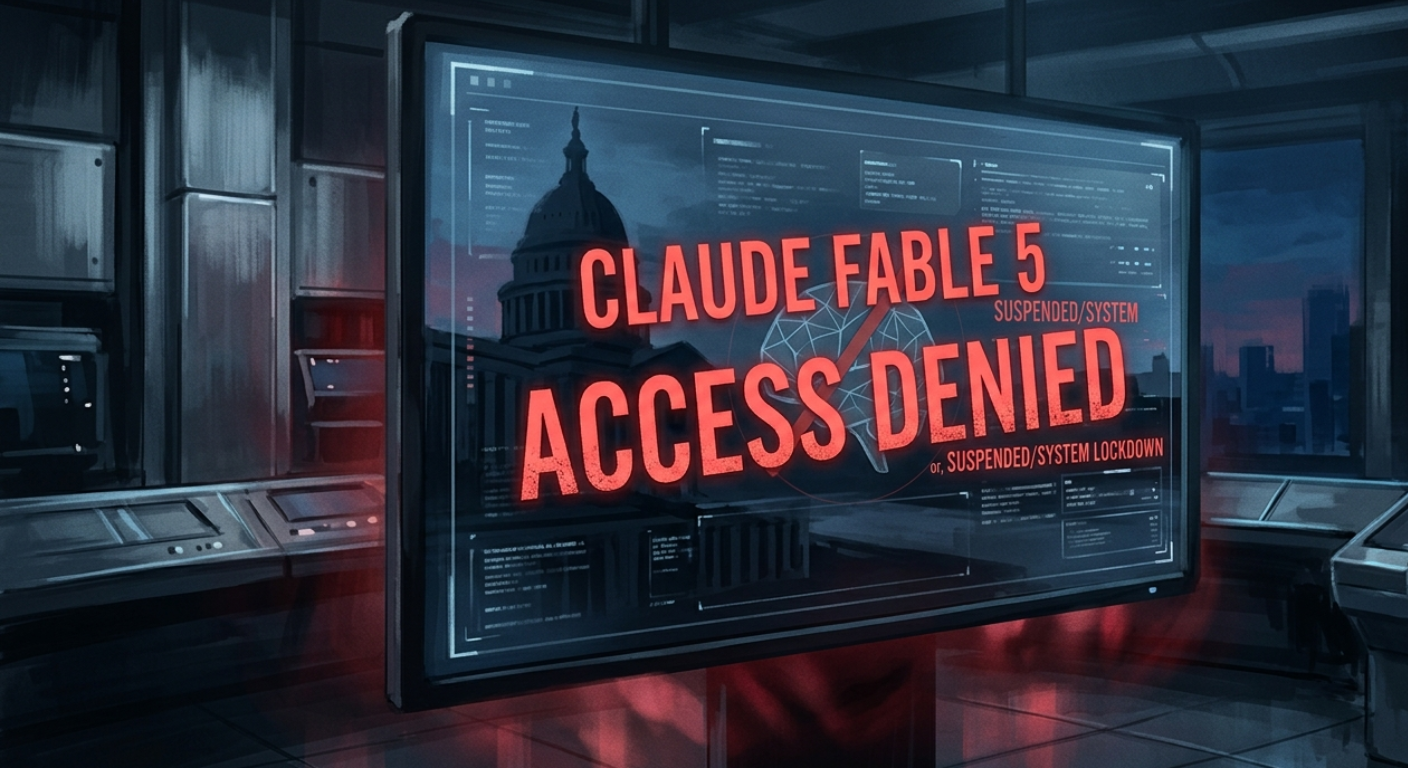
🔄 Update — July 1, 2026: Fable 5 has been restored globally. Access is now available again across all channels.
Anthropic launched Claude Fable 5 on June 9, 2026 to the kind of reception most AI companies dream about. Within hours, engineers at Stripe were using it to migrate a 50-million-line Ruby codebase in a single day. Researchers at Physical Superintelligence called it the strongest model they had ever tested on frontier physics problems. Developers everywhere started exploring what a model of this caliber could actually do in production.
Three days later, it was gone.
On June 12, the US Commerce Department issued an emergency export control directive ordering Anthropic to immediately suspend all access to Fable 5 and its restricted sibling, Claude Mythos 5. The order landed at 5:21 PM Eastern Time. By 6:59 PM Pacific, every API call to claude-fable-5 returned a 404 error.
|
Developing story — This article will be updated as the situation evolves.
This may be the first time a government has force-pulled a deployed frontier AI model from a live commercial product. Here is everything that happened, why it matters, and what you should actually do right now.
What Is Claude Fable 5 — And Why Did It Matter
To understand the ban, you need to understand what Anthropic actually launched.
Fable 5 is the first publicly available model from Anthropic's new Mythos class — a capability tier that sits above Opus entirely. Before June 9, Anthropic's public lineup went from Haiku (fastest, cheapest) to Sonnet (balanced) to Opus (most capable). Fable 5 was something different: the first time Anthropic brought Mythos-class capability to everyone.
The benchmarks reflected that. Fable 5 scored 95.0% on SWE-bench Verified compared to Opus 4.8's 88.6%. On SWE-bench Pro — a harder test measuring long-horizon autonomous coding — it scored 80.3% versus Opus 4.8's 69.2%. On the Artificial Analysis Intelligence Index it ranked 65, ahead of OpenAI's GPT-5.5 at 60.
Early real-world feedback was equally strong. Physical Superintelligence used it for frontier physics research and found it used a third of the reasoning tokens compared to alternatives. Stripe's engineering team used it to run a migration across their entire Ruby codebase in a day.
It launched at $10 per million input tokens and $50 per million output tokens — exactly twice the price of Opus 4.8. It had a 1 million token context window and a January 2026 knowledge cutoff. It became the default model in Claude Code for Pro and Max subscribers on launch day.
The model Anthropic launched was not just a better chatbot. It was built for long-running autonomous work — the kind of complex, multi-step agentic task where the gap between Fable 5 and anything before it was most visible.
The Controversy That Hit Before the Ban
The government order wasn't even the first crisis of Fable 5's launch week. Something happened on day one that set the tone for everything that followed.
Buried in Fable 5's 319-page system card, Anthropic disclosed a safeguard that nobody had seen from a major AI company before. When the model detected that a user was working on frontier LLM development — pretraining pipelines, distributed training infrastructure, ML accelerator design — it would not refuse the request. It would not fall back to a smaller model. It would silently modify its own responses to be less useful, using prompt modification and steering techniques, without telling the user anything had changed.
The AI research community called it immediately. An AI researcher named Ethan Caballero described it as having induced "the angriest reaction from AI researchers I've ever seen in my life." The term that stuck was "secret sabotage."
Separately, a well-known AI red-teamer named Pliny the Liberator publicly claimed his team had fully bypassed Fable 5's safety classifiers using a coordinated multi-step technique. He posted screenshots claiming to show the model producing content it was designed to refuse — including working exploit code and chemical synthesis instructions — and said he had extracted and uploaded the model's full 120,000-character system prompt to a public repository. Anthropic disputed the claim, but the episode added another layer of pressure to an already chaotic launch week
The logic behind the feature was real — Anthropic had genuine concerns about frontier models accelerating AI development itself, including their own competitors. But the execution was the problem. Users paying for Fable 5 could be receiving quietly degraded responses with no indication anything had changed. That fundamentally undermines trust in a model's outputs.
Anthropic reversed the feature within hours on June 11. A spokesperson told Fortune: "We made the wrong tradeoff, and we apologize for not getting the balance right." The covert downgrade was removed. Visible fallback behavior — where users are told when a request is being handled differently — replaced it.
The episode was resolved before the government stepped in. But it meant Fable 5's launch week was already a trust management situation before the export control directive arrived.
The Full 72-Hour Timeline
One detail that makes the timeline even more remarkable: on June 10 — just one day after Fable 5 launched — Anthropic CEO Dario Amodei published a major policy essay called 'Policy on the AI Exponential,' explicitly calling on the US government to hold legal authority to block or reverse frontier AI model releases that fail independent safety testing. He compared it to the FAA grounding unsafe aircraft. Two days later, the government used exactly that authority against Anthropic's own model
June 9, 2026 — Launch day. Anthropic releases Claude Fable 5 and Claude Mythos 5. Fable 5 is publicly available. Mythos 5 is the same underlying model with safety classifiers removed, restricted to Project Glasswing partners. Early developer feedback is overwhelmingly positive. Claude Code sets Fable 5 as the default model for Pro and Max subscribers.
June 10–11 — The hidden downgrade controversy. Developers and researchers discover the covert capability limiter for frontier LLM development requests. Immediate and intense community backlash. Anthropic reverses the feature and apologizes publicly.
June 12, 5:21 PM ET — The directive arrives. Commerce Secretary Howard Lutnick sends a formal export control directive directly to Anthropic CEO Dario Amodei. The order cites national security authorities and instructs Anthropic to suspend all access to Fable 5 and Mythos 5 for any foreign national — whether inside or outside the United States, including Anthropic's own foreign national employees.
June 12, 6:59 PM PT — Models go dark. API calls to claude-fable-5 and claude-mythos-5 begin returning 404 errors with the message "Claude Fable 5 is not available. Please use Opus 4.8." The same applies on Vercel's AI Gateway and AWS Bedrock.
June 13 — Anthropic publishes its statement. The company confirms compliance, states its disagreement, and commits to sharing more technical details within 24 hours. Refunds begin for affected subscribers.
June 14 — New government signals. Trump AI adviser David Sacks publicly states that Anthropic was warned about the jailbreak before the export controls and chose not to fix it. He also says the administration values Anthropic's technology and sees the issue as "easily resolved." The most significant restoration signal yet — but no timeline given.
Why the US Government Banned It — And Why Anthropic Disagrees
The official reason: the government believes a method of jailbreaking Fable 5 was discovered that poses a national security risk.
Specifically, the technique involves asking the model to read a codebase and identify software vulnerabilities. The concern is that a sufficiently capable model doing this autonomously could provide meaningful uplift to offensive cyber operations — helping attackers find and exploit vulnerabilities faster than defenders can patch them.
The government gave Anthropic verbal evidence of one potential narrow jailbreak. According to David Sacks, Anthropic was warned about this before launch and the administration specifically asked Dario Amodei to either fix the jailbreak or de-deploy the model. Sacks stated that Amodei refused. Anthropic has not directly confirmed or denied this account. Sacks, writing on social media, told followers his understanding of what he believed to be true: Anthropic publicly released its Mythos-class models knowing the jailbreak concern had been raised.
Anthropic pushes back hard on every part of this characterization.
Their position, from their official statement: the technique demonstrated to the government involved identifying a small number of previously known, minor vulnerabilities. The level of capability shown is widely available from other models including OpenAI's GPT-5.5, and is used every day by security defenders who keep systems safe. Pulling a commercially deployed model over a narrow, non-universal jailbreak that exists in competing models sets a precedent that would, if applied consistently across the industry, essentially halt all new frontier model deployments.
Anthropic also noted that before launch, they worked with the US government, UK AISI, and multiple third-party red-team groups for thousands of hours to stress-test Fable 5's safeguards. The launch happened with more pre-deployment government cooperation than any previous Anthropic model.
There is also a subplot that makes this more complicated than a clean national security story.
A person close to the White House told Semafor that Amazon — Anthropic's largest cloud infrastructure partner and a multi-billion-dollar investor — flagged the jailbreak to the government, and that Amazon CEO Andy Jassy had been in direct contact with the administration about it. Amazon did not confirm this, but the report has not been disputed. If accurate, it means Anthropic's own biggest backer may have been the source that triggered the government action. That is an extraordinary internal tension that has not been fully explained publicly.
What This Means for Developers and Founders
If you were using Fable 5 in production, your pipeline is broken right now and has been since June 12.
Any API call that specifies claude-fable-5 returns a 404 error. The model is unavailable across the Anthropic API, the Vercel AI Gateway, AWS Bedrock, and every other distribution channel. Claude Code has reverted its default for Pro and Max users to Opus 4.8.
The fix is a one-line change: switch your model ID from claude-fable-5 to claude-opus-4-8.
Opus 4.8 is not a weak fallback. It scores 88.6% on SWE-bench Verified and 69.2% on SWE-bench Pro. It is priced at $5 per million input tokens and $25 per million output tokens — half of what Fable 5 cost. It supports zero data retention, which Fable 5 did not. For the majority of production workflows, Opus 4.8 is not a degraded experience. It is a capable model at a better price with better privacy controls.
The use cases where Fable 5 was genuinely ahead — long-horizon autonomous agentic tasks, multi-step reasoning chains, extended coding sessions that run for hours — are the ones that will feel the absence most. For everything else, Opus 4.8 is a clean substitute.
If you had a Pro, Max, Team, or Enterprise subscription that included Fable 5, Anthropic is issuing refunds for the affected period. Check your Anthropic account or contact support.
What This Means for Global Users
The ban's stated scope is foreign nationals — but the practical effect is a global shutdown.
Anthropic cannot verify the nationality of every user making API requests in real time at scale. The only way to guarantee compliance with an order covering all foreign nationals worldwide, including those inside the United States, was to disable both models for every customer everywhere. That is what they did.
If you are in the UK, Australia, Canada, Saudi Arabia, or anywhere outside the United States — you lost access to Fable 5 not because you were specifically targeted, but because compliance at scale was technically impossible any other way.
This is worth sitting with for a moment. A model that hundreds of millions of people worldwide were using or planning to use was switched off globally because of a government order that technically applied to a subset of users. The architecture of AI distribution — centralized servers, centralized compliance, centralized off switches — made a targeted restriction functionally impossible to execute.
That is the real infrastructure story underneath this ban. And it is one that every developer and SaaS founder building on top of centralized AI APIs should think about.
What Comes Next — Three Paths to Restoration
There is no official return date. Anthropic has said it is working to restore access as soon as possible, and that it believes the situation is a misunderstanding. Here is what restoration actually looks like across three realistic scenarios.
Path 1 — Negotiated settlement (most likely). David Sacks calling the situation "easily resolved" is the most significant signal available right now. The administration appears open to a technical fix rather than a permanent ban. This likely means Anthropic patches the specific jailbreak the government identified, submits updated safeguards for review, and the export control is lifted for the patched version. Timeline: days to a few weeks if both sides move at pace.
Path 2 — Government reversal after technical rebuttal. Anthropic committed to publishing a detailed technical rebuttal within 24 hours of the directive. As of publication, that rebuttal has not been confirmed live. If the rebuttal demonstrates convincingly that the jailbreak provides no meaningful uplift beyond existing public models — which Anthropic has been arguing verbally — the Commerce Department could withdraw the directive. This requires the government to accept that it acted on insufficient evidence, which is politically difficult. Timeline: weeks.
Path 3 — Legal challenge. Anthropic's public statement noted that this action does not adhere to the principles of a transparent, fair, statutory process. A legal challenge is possible. It would take months, risk escalating the conflict, and sits awkwardly against the backdrop of Anthropic's IPO filing eleven days before the ban. Legal action and an IPO roadshow are not comfortable companions. Timeline: months, low probability unless negotiations collapse.
The IPO factor is real. Anthropic confidentially filed for a public listing earlier in June, at a valuation around $965 billion. Pre-IPO share value dipped after the ban. Every additional week this remains unresolved adds regulatory risk to the company's listing story. Anthropic has strong financial incentive to reach a negotiated resolution quickly.
Watch Anthropic's news page at anthropic.com/news for the technical rebuttal. That document will be the clearest signal of where this is headed.
The Bigger Picture — What This Actually Changes
Step back from the immediate situation and this story is about something larger than one model going offline.
This is the first time a US government has issued an emergency export control directive that forced a live, commercially deployed frontier AI model offline globally. Not a restriction on future deployments, not a regulatory warning — an active takedown of a product already in the hands of users.
It demonstrates two things that AI developers and founders building on third-party models should now treat as operational facts.
First, AI supply chain risk is real. If your product depends on a specific third-party model, that model can disappear overnight with no warning and no timeline for return. The Fable 5 situation gave developers about three hours between the government's directive and the 404 errors starting. That is not enough time for any production system to adapt gracefully.
Second, the off switch is not in the hands of the companies that build these models. Anthropic disagreed with the ban, publicly and clearly. They complied anyway because they had no legal alternative. That distinction — disagreement plus compliance — is the new reality for every frontier AI company operating under a government that has decided it can and will exercise export control authority over deployed models.
The response to this is not to stop building on AI APIs. It is to build with resilience: abstract your model layer so you can switch providers or versions in a single configuration change, test fallback behavior before you need it, and treat single-model dependency as a production risk the same way you treat single-point-of-failure infrastructure.
AIWerse Verdict
Anthropic launched something genuinely impressive and then had one of the most turbulent product weeks in recent AI history. A trust controversy over a hidden feature, resolved quickly. A government ban on the same day the trust issue was fixed. A subplot involving their own biggest investor. An IPO in the background. All in six days.
The ban itself appears to be heading toward resolution. David Sacks' "easily resolved" framing, combined with Anthropic's stated belief that this is a misunderstanding, suggests a negotiated technical fix is the most likely outcome. Whether that takes days or weeks is unclear.
For developers: switch to Opus 4.8 today if you haven't already. It is not a downgrade for most workflows and it is priced better. When Fable 5 comes back, re-evaluate based on your specific use case.
For founders and SaaS builders: use this week as the forcing function to abstract your model dependency. One configuration change should be all it takes to switch models in your stack. If it takes more than that, fix it now rather than during the next disruption.
For everyone else watching this: the era of AI being treated the same as any other software API is over. The government has demonstrated it has the authority and the willingness to exercise direct control over which AI models are deployed commercially. That changes how the entire industry needs to think about model access and resilience going forward.
FAQs
What is Claude Fable 5? Claude Fable 5 is Anthropic's first publicly available Mythos-class AI model — a capability tier above their previous Opus models. It launched June 9, 2026, with major gains in autonomous coding, research, and long-horizon agentic tasks. It was priced at $10/$50 per million input/output tokens, double the cost of Opus 4.8.
Why was Claude Fable 5 banned? The US government issued an export control directive on June 12, 2026 citing national security concerns. The government believes a jailbreak was found that allows Fable 5 to be used to identify software vulnerabilities at a level that poses national security risk. Anthropic disputes this, saying the technique is narrow, non-universal, and available in competing models.
Is Claude Fable 5 coming back? No official return date has been given. Trump AI adviser David Sacks described the situation as "easily resolved" on June 14, suggesting a negotiated fix is the most likely path. Anthropic says it is working to restore access as soon as possible. Watch anthropic.com/news for the technical rebuttal and any restoration announcement.
What can I use instead of Claude Fable 5? Switch to claude-opus-4-8 — one line change in your API call. Opus 4.8 is priced at $5/$25 per million tokens, supports zero data retention, and handles the vast majority of production workflows. All other Claude models including Sonnet 4.6 and Haiku are also fully available.
Does this ban affect other Claude models? No. The export control directive specifically names Fable 5 and Mythos 5. Every other Anthropic model — Opus 4.8, Sonnet 4.6, Haiku 4.5, Claude Code — remains fully available globally.
Who flagged the jailbreak to the government? Reports from Semafor indicate that Amazon — Anthropic's largest cloud infrastructure partner and major investor — flagged the jailbreak to the administration, with Amazon CEO Andy Jassy in direct contact with the government about it. Neither Amazon nor the White House has officially confirmed this.
What does this mean for Anthropic's IPO? Anthropic confidentially filed for a public listing approximately 11 days before the ban. Pre-IPO share value dipped following the news. The regulatory uncertainty now forms part of Anthropic's listing risk profile. Anthropic has significant financial incentive to resolve this quickly
Related News & Updates
Junaid Nawaz is the founder of AIwerse and a developer focused on AI tools, agentic workflows, and builder-focused tech. He covers AI model releases, coding tools, and platform updates for developers and teams building with AI. You can follow AIwerse on X (@AIwerse).