
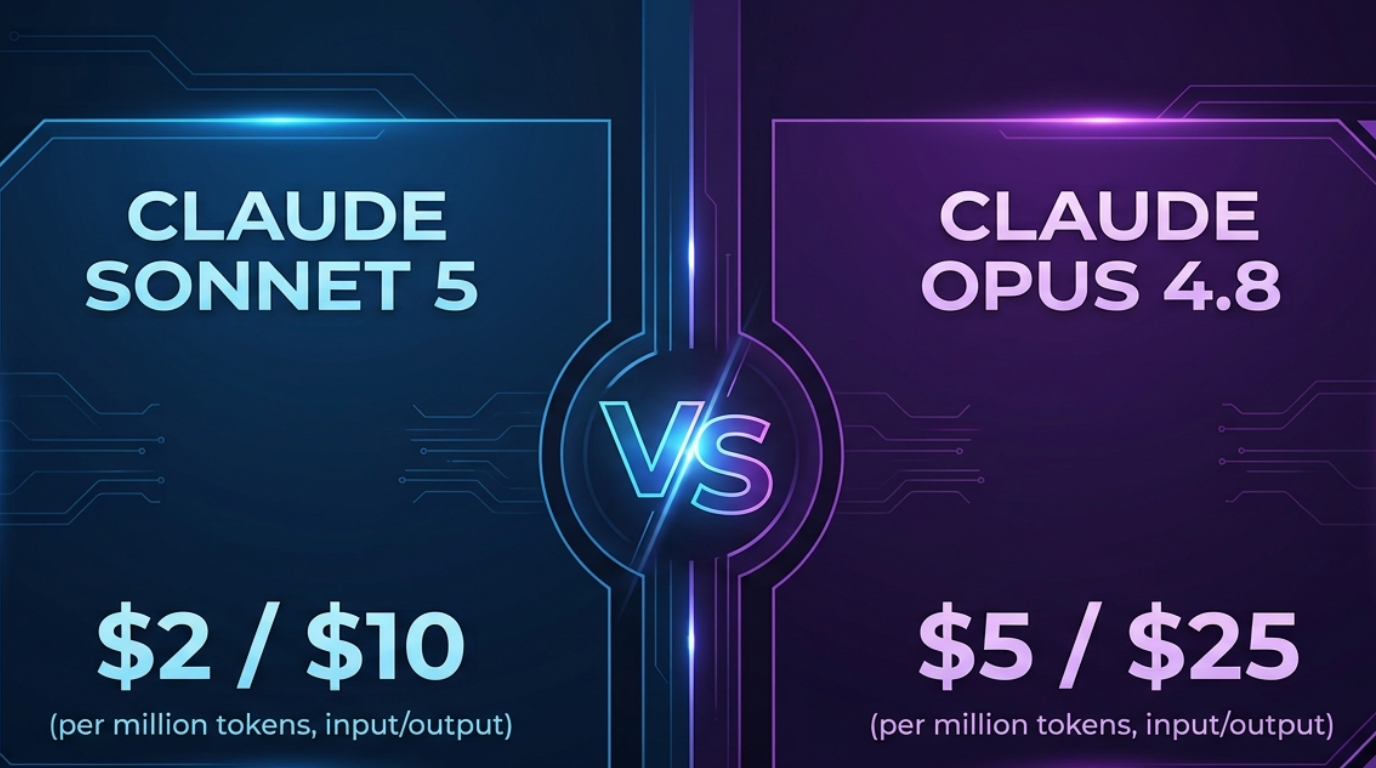
Quick VerdictUse Claude Sonnet 5 as your default. Escalate to Opus 4.8 only when you're hitting the hardest multi-file coding jobs, deep mathematical reasoning, or accuracy-critical autonomous tasks where a 6-point benchmark gap actually costs you in production. For the majority of real workloads — production agents, customer-facing chatbots, everyday coding, content pipelines, research assistants — Sonnet 5 is now the right call. It's cheaper, faster, and for the first time, genuinely close enough to Opus 4.8 that the premium rarely makes sense. That said, "close enough" isn't "identical." This article gives you the actual cost math, the benchmark breakdown that matters, and a routing decision you can copy directly into your own stack. |
|---|
What Just Shipped
Anthropic launched Claude Sonnet 5 on June 30, 2026 — positioning it as the most agentic Sonnet model ever built. It's live across every Claude plan right now:
Free and Pro plans: Sonnet 5 is the new default model
Max, Team, and Enterprise: Available and selectable
Claude Code and Claude Platform: Live immediately
API: Available introductory pricing of $2 per million input tokens and $10 per million output tokens, then moving to standard pricing of $3/$15
This isn't a minor version bump. Anthropic's framing is explicit: Sonnet 5 is about agentic reliability — longer task chains without losing context, better self-correction when a tool call fails, steadier behavior across extended sessions. The headline benchmark gains are real, but the day-to-day improvement is in how the model handles itself when things get complicated.
It also uses an updated tokenizer — the same one introduced with Opus 4.7. This matters for your cost math, and we'll cover it properly below.
Benchmarks That Actually Matter
Here's Anthropic's comparison across Sonnet 5, Sonnet 4.6 (its predecessor), and Opus 4.8:
Benchmark | Sonnet 4.6 | Sonnet 5 | Opus 4.8 |
|---|---|---|---|
SWE-bench Pro (agentic coding) | 58.1% | 63.2% | 69.2% |
SWE-bench Verified | — | 85.2% | 88.6% |
OSWorld-Verified (computer use) | 78.5% | 81.2% | 83.4% |
Terminal-Bench 2.1 | 67.0% | 80.4% | 74.6% |
Humanity's Last Exam (with tools) | — | 57.4% | 57.9% |
USAMO 2026 (olympiad math) | — | 79.5% | 96.7% |
GDPval-AA v2 (knowledge work) | — | 1,618 | 1,615 |
What this actually tells you:
Sonnet 5 beats its predecessor across every tested category. It closes the gap to Opus 4.8 significantly — and in two specific areas it pulls ahead or ties: Terminal-Bench (80.4% vs 74.6%) and knowledge work (1,618 vs 1,615). These aren't rounding errors. Sonnet 5 is genuinely stronger at complex command-line workflows and professional knowledge tasks than Opus 4.8.
Where Opus 4.8 still has a real lead: agentic coding on large multi-file repositories (6-point gap on SWE-bench Pro), and especially deep mathematical reasoning where the USAMO 2026 gap is 17 points. That's a genuine tier difference — not noise.
For most developers reading this: the coding gap matters when you're doing long-horizon multi-file diffs on production repos. For everyday feature development, refactoring, and tool-use — Sonnet 5 is close enough that you won't notice the difference.
The Real Cost Math
This is the section most comparison articles skip. Let's actually run the numbers.
Standard API pricing:
Model | Input (per 1M tokens) | Output (per 1M tokens) |
|---|---|---|
Sonnet 5 (intro, until Aug 31) | $2 | $10 |
Sonnet 5 (standard, Sep 1+) | $3 | $15 |
Opus 4.8 | $5 | $25 |
On the surface: Sonnet 5 is 40% cheaper at standard rates, and 60% cheaper during the introductory window.
The tokenizer caveat — and why it changes the math:
Sonnet 5 uses an updated tokenizer. The same input text maps to 1.0–1.35x more tokens on Sonnet 5 depending on content type. Anthropic set introductory pricing specifically to make the Sonnet 4.6 → Sonnet 5 transition roughly cost-neutral. But once standard pricing kicks in on September 1, you need to factor this in.
Worked example — output-heavy agent workload:
Suppose your current Opus 4.8 spend is $1,000/day. Here's the realistic comparison:
Opus 4.8 at $5/$25: $1,000/day
Sonnet 5 at $3/$15 (standard): roughly $400–$500/day depending on tokenizer impact on your specific content type
Sonnet 5 at $2/$10 (intro): roughly $300–$400/day
For a team running production agents at scale, that's $15,000–$21,000/month in savings. That's the real money.
When Sonnet 5 can cost MORE than Opus 4.8:
At the xhigh effort level (Sonnet 5's extra-high reasoning mode), token usage spikes significantly. If you're running Sonnet 5 at xhigh on complex tasks, the cost-per-task can actually exceed Opus 4.8 at standard effort. This is a real edge case but worth knowing if you're doing heavy reasoning-intensive workloads at scale.
Practical rule: Default to Sonnet 5 at medium effort. Reserve xhigh for tasks where you'd have reached for Opus anyway. Use Opus 4.8 directly for hardest-tier work — it's cleaner than running Sonnet 5 at xhigh.
Where Opus 4.8 Still Wins
Being honest here matters for credibility, so let's be direct.
Stick with Opus 4.8 for:
1. Hard multi-file repository coding SWE-bench Pro's 6-point gap (69.2% vs 63.2%) reflects real-world performance on large, actively-maintained codebases with messy, context-heavy diffs. If your Claude Code sessions involve long-horizon engineering work across many files simultaneously, Opus 4.8's judgment advantage is measurable.
2. Olympiad-level mathematics and deep reasoning The 17-point USAMO gap is not noise. Sonnet 5 at 79.5% is still excellent — but for research teams, math-heavy applications, or anything requiring formal proof-level reasoning, Opus 4.8 at 96.7% is genuinely in a different tier.
3. Cybersecurity-sensitive tasks Anthropic is explicit: they recommend Opus 4.8 for cybersecurity work requiring reduced guardrails. Sonnet 5's cyber capability is intentionally lower and its safeguards are stricter. If you're doing sanctioned penetration testing, vulnerability research, or security-adjacent agentic workflows — Opus 4.8 is the call.
4. Accuracy-critical autonomous agents When a mistake is expensive and self-correction matters more than speed, Opus 4.8's "noticeably better judgment" — asking the right questions, catching its own mistakes, pushing back on flawed plans — is worth the premium.
The Default vs Escalate Playbook
This is the routing decision you can copy directly into your stack.
Workload | Default Model | Escalate To |
|---|---|---|
High-volume production agents | ✅ Sonnet 5 | — |
Customer-facing chatbots | ✅ Sonnet 5 | — |
Content generation at scale | ✅ Sonnet 5 | — |
Real-time research and analysis | ✅ Sonnet 5 | — |
Everyday coding and feature work | ✅ Sonnet 5 | — |
Multi-file refactoring (medium repos) | ✅ Sonnet 5 | Opus 4.8 if failing |
Long-horizon multi-file engineering | — | ✅ Opus 4.8 |
Deep mathematical/proof-level reasoning | — | ✅ Opus 4.8 |
Cybersecurity / sanctioned security work | — | ✅ Opus 4.8 |
Accuracy-critical autonomous decisions | — | ✅ Opus 4.8 |
Sonnet 5 at xhigh effort repeatedly failing | — | ✅ Opus 4.8 |
API model strings: Swap at the model string level. Everything else in your stack stays the same — context window (1M tokens), max output (128K), batch API support, and knowledge cutoff (January 2026) are identical across both models.
Sonnet 5:
claude-sonnet-5Opus 4.8:
claude-opus-4-8
What This Means for Claude Code and Agent Pipelines
If you're building with Claude Code, running LangGraph pipelines, or orchestrating multi-step automation — here's what actually changed with Sonnet 5 beyond the benchmark numbers.
Longer task chains without context loss. Previous Sonnets would sometimes drift or lose thread on extended agentic sessions. Sonnet 5's improvements specifically target this: it holds context better across longer chains, which directly reduces the "it got confused halfway through" failure mode that wastes tokens and requires human intervention.
Better self-correction on tool call failures. When a tool call fails or returns unexpected output, Sonnet 5 is more likely to recognize the issue, adapt its approach, and continue rather than stall or compound the error. For agent pipelines where you're not babysitting every step, this is a meaningful reliability improvement.
Steadier behavior in Claude Code sessions. If you're using Claude Code for longer engineering sessions — the kind where you're handing off a complex feature and stepping away — Sonnet 5 is noticeably more consistent in staying on task. This is Anthropic's own framing, and it matches what early developers reported on launch day.
The effort dial matters for pipeline cost management. Sonnet 5's effort levels (low, medium, high, xhigh) give you direct control over the reasoning-cost tradeoff per task. For a multi-step agent pipeline, you can route low-complexity steps to low/medium effort and reserve high effort for the reasoning-heavy nodes. This is a cost optimization lever that Sonnet 4.6 didn't expose as cleanly.
One practical implication for LangGraph builders: If you're routing between models in your graph (a common pattern — use a cheaper model for initial steps, escalate to a more capable one for complex nodes), you now have a cleaner default architecture: Sonnet 5 as your backbone model, Opus 4.8 as your escalation target. The cost math supports this, and the capability gap is small enough that you'll escalate less often than you think.
FAQS
Is Claude Sonnet 5 better than Opus 4.8?
For most workloads, Sonnet 5 is the better choice — not because it's more capable overall, but because it delivers 90%+ of Opus 4.8's performance at 40–60% lower cost. Where raw capability is the constraint (hardest coding, deep reasoning, cybersecurity), Opus 4.8 is still superior.
Which Claude model should I use in 2026?
Start with Sonnet 5. It's now the default on Free and Pro plans for a reason. Upgrade to Opus 4.8 only when you've identified a specific task where Sonnet 5 consistently falls short.
How much cheaper is Sonnet 5 than Opus 4.8?
At standard pricing: 40% cheaper ($3/$15 vs $5/$25). During the introductory window (until August 31, 2026): 60% cheaper ($2/$10). Factor in the 1.0–1.35x tokenizer multiplier for Sonnet 5 — actual savings on a given workload will be slightly less than the headline rate difference suggests.
Does the tokenizer change affect my existing prompts?
Yes, potentially. The same prompt sent to Sonnet 5 may use more tokens than on Sonnet 4.6, depending on content type. Anthropic set introductory pricing to roughly offset this. After September 1, test your highest-volume prompts to validate actual cost-per-task before assuming the full 40% savings applies.
Can I use Sonnet 5 in Claude Code?
Yes — Sonnet 5 is live in Claude Code from launch. It's actually a natural fit for Claude Code's agentic workflows given Sonnet 5's specific improvements in task-chain reliability and self-correction.
What about Fable 5?
Fable 5 returned globally on July 1, 2026 after a brief government-ordered suspension. It sits above both Sonnet 5 and Opus 4.8 in capability.
AIWerse Opinion
Claude Sonnet 5 is the right default for 2026. The pricing math alone makes a strong case — but the agentic reliability improvements are what actually change daily workflows. For the first time, a Sonnet-tier model is close enough to Opus that the upgrade decision needs a specific reason, not just a vague "I want the best."
Make Sonnet 5 your backbone. Route the hardest tasks to Opus 4.8. Revisit that routing logic after August 31 when standard pricing lands — and account for the tokenizer when you do.
If you're building agent pipelines, Claude Code sessions, or production API integrations right now, the upgrade path is a single model string change. Start there.
Junaid Nawaz is the founder of AIwerse and a developer focused on AI tools, agentic workflows, and builder-focused tech. He covers AI model releases, coding tools, and platform updates for developers and teams building with AI. You can follow AIwerse on X (@AIwerse).