
Quick summary:As of July 30, 2026, Amazon Bedrock Agents — now renamed
|
|---|
Amazon Bedrock Agents, the service AWS launched in November 2023, was renamed Bedrock Agents Classic and, as of July 30, 2026, is closed to new customers. Several early reports have framed this as AWS "killing" or "retiring" its flagship agent product. That framing overstates what actually happened. The mechanism is narrower, and understanding the real details matters for anyone currently building — or about to start building — production AI agents on AWS.
What Actually Changed
Per AWS's own maintenance-mode documentation, the restriction applies to exactly two API calls: CreateAgent and InvokeInlineAgent. Any AWS account that has called either of these in the past 12 months is automatically allowlisted and continues to operate with no changes at all. Accounts without that usage history now receive an AccessDeniedException (HTTP 403) if they attempt to create a new agent.
Every other part of the service remains fully available to all customers, allowlisted or not: UpdateAgent, GetAgent, ListAgents, DeleteAgent, PrepareAgent, InvokeAgent, action group APIs, knowledge base APIs, and alias APIs all continue to function. Existing Bedrock models, Knowledge Bases, and Guardrails are entirely unaffected by this change. There is also no migration deadline — Bedrock Agents Classic remains supported in maintenance mode indefinitely, with AWS stating there is no planned end-of-life date.
The one hard limitation going forward: the model catalog available inside Bedrock Agents Classic is frozen as of July 30, 2026. Any foundation model AWS releases after this date will be available through Amazon Bedrock itself and through AgentCore, but not through the Classic orchestration layer. This restriction applies only to the agent orchestration layer — Bedrock's core model inference, Knowledge Bases, and Guardrails continue to receive new models as normal.
Visit Documentation: AWS Bedrock Agents maintenance mode documentation
What Amazon Bedrock AgentCore Actually Is
Amazon Bedrock AgentCore is not a renamed or repackaged version of Bedrock Agents. It reached general availability in October 2025 as a separate, more comprehensive platform: a framework-agnostic, model-agnostic runtime for building, deploying, and operating production AI agents at scale. AWS describes it as supporting any framework — LangChain, LangGraph, the OpenAI Agents SDK, the Claude Agent SDK, Strands, or custom code — and any model, including providers outside Bedrock.
AgentCore offers two distinct ways to build:
Managed Harness | Code-Defined Agents | |
|---|---|---|
Approach | Config-based: declare model, tools, and instructions | Full custom orchestration code |
Closest analog to | Bedrock Agents Classic's managed experience | Advanced, framework-driven agent development |
Multi-agent collaboration | Limited — agent-as-tool pattern only | Full support via custom framework code |
Best for | Straightforward agents migrating from Classic | Complex orchestration, existing framework codebases |
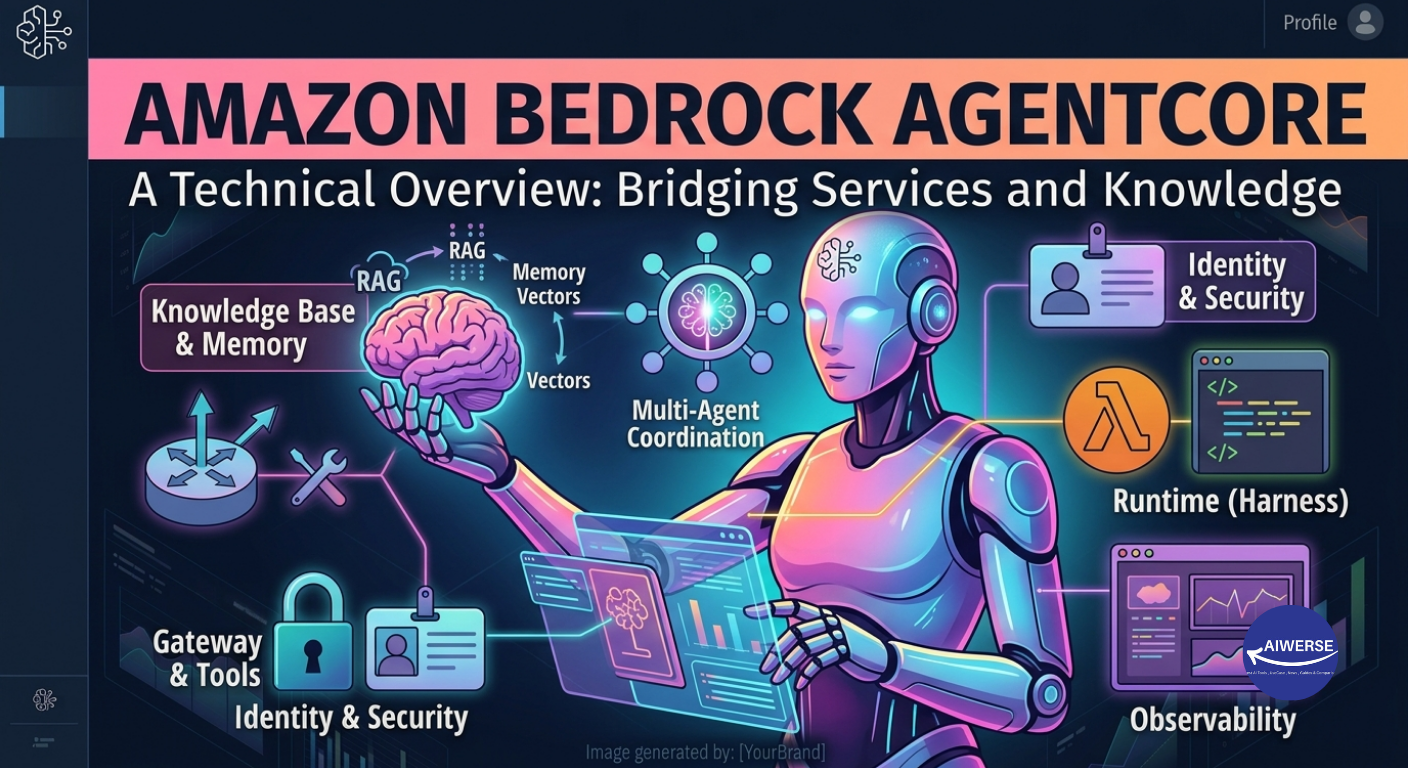
The platform's core services are Runtime (serverless agent execution), Gateway (turns REST APIs, Lambda functions, and MCP servers into agent-usable tools with access control), Memory (short and long-term memory with configurable strategies), Identity (authentication and authorization for tool calls), and Observability (persistent, end-to-end tracing of agent actions).
Worth noting for teams currently on Bedrock Agents Classic: AWS's own capability-comparison documentation is upfront that the migration isn't a perfect one-to-one swap. Classic's built-in AMAZON.UserInput tool for automatic reprompting maps to AgentCore's "inline function tools" pattern, but requires explicit tool definition rather than working automatically. Full multi-agent collaboration with supervisor routing — straightforward in Classic — currently requires custom framework code on AgentCore rather than a built-in feature.
Visit: AgentCore Developer Guide
Pricing: More Flexible, Also More Complex
Bedrock Agents Classic had a simple pricing model: no separate charge for the orchestration layer itself, with costs limited to underlying model inference and any connected resources like Lambda invocations. AgentCore replaces that with consumption-based pricing spread across as many as 12 independently billed components, several of which have distinct billing units:
Component | Billing Basis |
|---|---|
Runtime | $0.0895 per vCPU-hour, $0.00945 per GB-hour (active use only) |
Gateway | Per 1,000 API calls (MCP operations, search, tool indexing) |
Memory | Per record created and retrieved |
Code Interpreter / Browser | Active vCPU-hour and GB-hour |
Observability | Routed through Amazon CloudWatch pricing |
Model inference | Standard Bedrock per-token rates for the model selected |
AWS states there is no separate charge for the harness orchestration layer itself, and that AgentCore's harness is more token-efficient than Classic's internal prompt structure — meaning inference costs may end up comparable or lower even with the added platform-level billing. New AWS accounts receive up to $200 in free-tier credits to offset initial evaluation.
The practical takeaway for anyone estimating costs: model inference token spend is still typically the largest line item for most production agents, but Runtime and Memory usage can become meaningful once an agent runs longer sessions or maintains extensive long-term memory.
Visit Pricing: Amazon Bedrock AgentCore Pricing Page
Bedrock AgentCore vs LangGraph: Different Layers, Not Competitors
A common point of confusion, and one worth clearing up directly: AgentCore and LangGraph are not really alternatives to each other. LangGraph is an orchestration framework — it defines how an agent's logic is structured, as a graph of nodes and state, and requires separate infrastructure to actually run. AgentCore is a runtime — it decides where and how an agent executes: hosting, scaling, session state, and tool access.
These layers compose rather than compete. AWS publishes first-party integrations and tutorials for running LangGraph agents directly on AgentCore, including AgentCoreMemorySaver and AgentCoreMemoryStore classes that let LangGraph's checkpoint and memory-store patterns use AgentCore Memory as their backing store. In practice, a team already invested in LangGraph doesn't need to abandon it to adopt AgentCore — they can deploy the same LangGraph code on AgentCore's managed runtime and gain production infrastructure without a framework rewrite.
The decision that actually matters isn't "LangGraph or AgentCore" — it's whether you want a managed, AWS-native runtime under whatever framework you choose, versus self-managing that infrastructure yourself.
Bedrock AgentCore vs n8n
This comparison needs a different frame than the LangGraph one, because n8n and AgentCore aren't solving the same problem. n8n is a visual, general-purpose workflow-automation platform — it excels at connecting SaaS tools, APIs, and simple conditional logic through a drag-and-drop interface, and it can incorporate AI model calls as one node type among many. AgentCore is a code-first, AWS-native runtime purpose-built specifically for hosting production AI agents at scale, with deep infrastructure for memory, tool access control, and observability that a general workflow tool doesn't attempt to provide.
Teams building simple automations that occasionally call an AI model are typically better served by n8n's visual approach and faster setup. Teams building agent systems that need persistent memory, fine-grained tool authorization, and AWS-native scaling are the better fit for AgentCore. The two can also be used together — n8n can trigger workflows that call into an agent hosted on AgentCore.
Migrating from Bedrock Agents Classic
For teams that are allowlisted and have no urgent need to move, AWS is explicit that there's no deadline — Classic remains fully supported indefinitely. But since no new features or models will be added to Classic going forward, AWS recommends evaluating AgentCore for any new agent development.
The recommended path for straightforward agents (model, action groups, knowledge base) is the managed harness, which AWS states can be set up from an existing Classic configuration in a matter of hours via the AgentCore CLI. More complex agents using custom orchestrators or multi-agent supervisor patterns will require more substantial code work, since those patterns aren't currently available as built-in harness features.
Get CLI: AgentCore CLI
AIWerse Verdict
This is a real product transition dressed up in alarming headlines. The accurate framing is: if you're already building on Bedrock Agents, nothing changes for you today, and nothing is scheduled to change on any specific future date. If you're about to start a new agent project on AWS, your starting point has shifted to AgentCore — a genuinely more capable, if more complex, platform.
The most useful thing to understand before migrating anything is the layer distinction: AgentCore is infrastructure, not a framework replacement. If your team is already using LangGraph, Strands, or another framework, the migration story is about hosting, not rewriting agent logic. The bigger adjustment is pricing — moving from Classic's simple token-based cost model to AgentCore's multi-component billing means cost estimation now requires actually modeling your agent's session length, memory usage, and tool-call volume, not just its token consumption.
For teams evaluating whether to build new agent work on AWS at all: AgentCore's framework-agnostic design is a genuine strength — it doesn't lock you into Bedrock's own models or a single agent-building approach, which matters if your team wants flexibility to change frameworks or models later without a platform migration.
FAQs
Is Bedrock Agents Classic shutting down?
No. As of July 30, 2026, it's closed to new customers only. Existing accounts with prior usage continue to operate with no changes, and AWS has stated there is no planned end-of-life date for the service.
Does Bedrock Agents still work after July 30?
Yes, for any AWS account that used CreateAgent or InvokeInlineAgent in the prior 12 months. All existing agents, knowledge bases, and guardrails continue functioning normally for every account, allowlisted or not — only the creation of brand-new agents is restricted for non-allowlisted accounts.
What is Amazon Bedrock AgentCore?
AgentCore is AWS's framework-agnostic, model-agnostic runtime for building and operating production AI agents at scale. It reached general availability in October 2025 and provides five core services: Runtime, Gateway, Memory, Identity, and Observability.
Is Bedrock AgentCore a replacement for LangGraph?
No. AgentCore is a runtime; LangGraph is an orchestration framework. They operate at different layers and are designed to work together — AWS provides first-party integrations for running LangGraph agents on AgentCore's managed infrastructure.
How do I migrate from Bedrock Agents to AgentCore?
AWS recommends the managed harness for straightforward agents, which can be configured from an existing Bedrock Agents Classic setup using the AgentCore CLI. More complex agents using custom orchestrators or multi-agent collaboration require additional custom code, since some Classic features aren't directly replicated in the harness.
How much does Bedrock AgentCore cost?
Pricing is consumption-based across up to 12 separate components — including Runtime, Gateway, Memory, Browser, and Code Interpreter — in addition to standard Bedrock model inference costs. New AWS accounts receive up to $200 in free-tier credits.
Related News & Updates
Junaid Nawaz is the founder of AIwerse and a developer focused on AI tools, agentic workflows, and builder-focused tech. He covers AI model releases, coding tools, and platform updates for developers and teams building with AI. You can follow AIwerse on X (@AIwerse).