
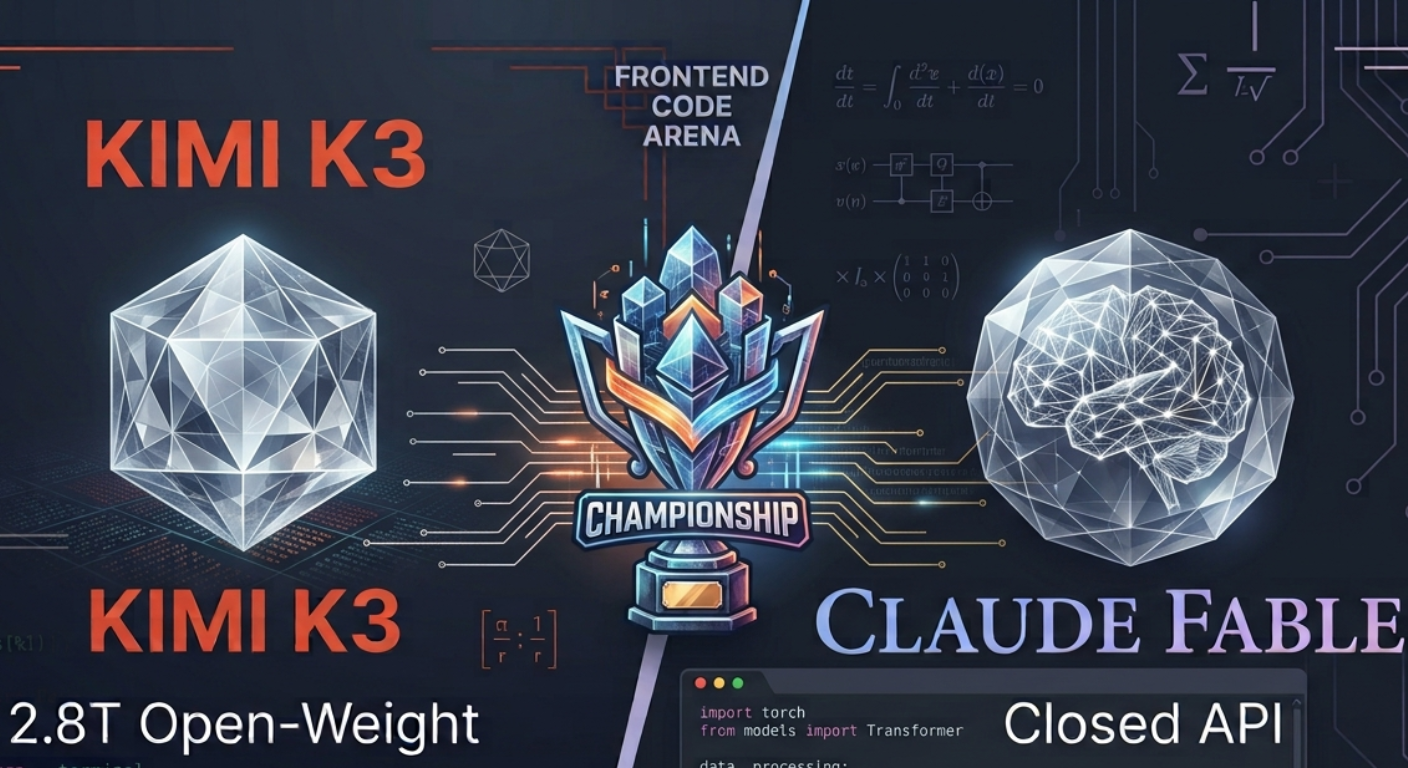
Quick summary:Kimi K3, a 2.8T-parameter open-weight model from Moonshot AI, topped Claude Fable 5 in the Frontend Code Arena (1,679 vs 1,631 points) on July 16, 2026 — winning 6 of 7 categories. It's dramatically cheaper ($0.30–$3/$15 per million tokens vs Fable 5's ~$10/$50) and open-weight (full release on July 27). But Fable 5 still holds an edge in complex multi-tool orchestration and audit-friendly reasoning. Full weights aren't public yet, so some numbers remain Moonshot-reported until July 27. Route high-volume, simple coding tasks to K3; keep complex multi-tool pipelines on Fable 5. |
|---|
On July 16, 2026, an open-weight model built in Beijing landed at #1 in the Frontend Code Arena — ahead of Claude Fable 5. Not GPT-5.6 Sol. Not Gemini. Claude Fable 5, Anthropic's newest agentic-coding flagship, in a blind developer-testing benchmark that's genuinely hard to game.
That got my attention as someone actually building agent stacks, not just reading about them. I've spent the last few months in LangGraph, wiring up tool calls, testing how models hold up over 20+ turn agent loops, watching where they break. So when a claim like "open-weight model beats Claude at coding" shows up, Our first question isn't "is this real" — it's "does this change what I'd actually route my agents to." Let's dig in.
What Kimi K3 Actually Is
Kimi K3 is Moonshot AI's newest flagship model, and according to Moonshot's own documentation, it's a 2.8 trillion parameter model — the first open-weight system in the 3-trillion-parameter class. It's built on two architectural changes: Kimi Delta Attention (KDA), a hybrid linear attention mechanism, and Attention Residuals, which change how information flows between layers as the model gets deeper.
The efficiency number worth sitting with: K3 uses a Stable LatentMoE framework that activates just 16 of its 896 experts per token — roughly 1.8% of the total parameter pool per forward pass. That sparsity is why a 2.8T-parameter model doesn't behave like a 2.8T-parameter model at inference cost. Moonshot claims this gives K3 roughly 2.5x the scaling efficiency of its predecessor, K2.
It also ships with a 1M-token context window and native visual understanding, meaning it can take screenshots and visual feedback as part of an agent loop — useful for frontend work, CAD, or anything where "does this look right" matters as much as "does this compile."
One important caveat, and I want to be upfront about it: full model weights aren't public yet. Moonshot says they'll release by July 27, 2026. Until then, every benchmark number is either Moonshot-reported or drawn from limited API access. That doesn't make the numbers wrong — but it does mean independent verification is still five days out as I'm writing this.
The Benchmark That Started This
The specific result driving the "Kimi beats Claude" headlines is the Frontend Code Arena — a blind developer-evaluation benchmark where real developers rate model outputs without knowing which model produced them. Kimi K3 landed at #1 with 1,679 points, ahead of Claude Fable 5, and ranked first in 6 of 7 sub-domains including brand/marketing tasks, reference-based design, and data/analytics work. That's a 17-place jump from Kimi's previous model, K2.6, which sat at #18.
Worth being precise about what this does and doesn't prove: it's one benchmark, focused specifically on frontend code generation as judged by human raters. Moonshot itself has said K3 still sits behind Fable 5 and GPT-5.6 Sol on overall performance across its full evaluation suite — it just outperformed everything else, including Claude Opus 4.8, on coding and agentic tasks specifically. So "Kimi beats Claude" is true and real, but it's true in a specific lane, not across the board.
Where the Real Difference Shows Up: Tool-Use Reliability
Raw coding benchmarks are actually the less interesting comparison if you're building agents rather than just generating code snippets. What matters more is how a model behaves inside a multi-step agent loop — does it call tools correctly, does it hold context over 20+ turns, does it know when to stop and check in versus when to keep going autonomously.
This is where independent comparisons (not Moonshot's own numbers) suggest a real tradeoff exists. Claude Fable 5 appears to have an edge in complex, multi-tool orchestration — fewer malformed function calls, more consistent structured output when an agent is juggling five or more distinct tools. Kimi K3 handles simpler tool chains well but shows more drift in heavily orchestrated pipelines.
The flip side is autonomy. Fable 5 is built with more frequent "check-ins" — it pauses to ask clarifying questions or flag uncertainty before making changes, which is a deliberate safety behavior from Anthropic. That's valuable if you want an audit trail or don't want irreversible edits happening unsupervised. It's a liability if you're running a fully autonomous batch pipeline that isn't built to handle interruptions. Kimi K3 leans more autonomous by default — which cuts both ways depending on what you're building.
If you're running a coding agent with more than five tools in play, or you need explainable reasoning for debugging and audit purposes, that's a real point in Fable 5's favor regardless of what a single frontend benchmark shows.
The Pricing Gap
This is where the comparison gets concrete.
Model | Input (cache hit) | Input (cache miss) | Output |
|---|---|---|---|
Kimi K3 | $0.30 / 1M tokens | $3 / 1M tokens | $15 / 1M tokens |
Claude Fable 5 | — | ~$10 / 1M tokens | ~$50 / 1M tokens |
Fable 5 pricing reflects Anthropic's metered rate after the one-time Pro-tier credit is used; K3 pricing is flat, pay-as-you-go with no context-length tiering.
Even accounting for K3's cache-miss pricing sitting higher than its cache-hit rate, the gap is real: for a coding agent making frequent repeated calls against similar context (which caching rewards heavily), K3 lands meaningfully cheaper per task. For workloads that don't benefit from caching — one-off, highly varied prompts — the gap narrows but doesn't disappear.
The honest caveat here: if Fable 5's better tool-use reliability means fewer failed runs, fewer retries, and fewer manual fixes, some of that raw token-cost advantage gets eaten by operational overhead. A cheaper model that fails 10% more often on complex pipelines isn't actually cheaper once you count engineering time.
You can visit both pricing here
What "Open-Weight" Actually Buys You
Beyond pricing, K3 being open-weight is a structurally different proposition than Fable 5's closed, API-only access. Once weights are public on July 27, open-weight status means:
Self-hosting — relevant if you're building for clients with data residency or compliance requirements (legal, healthcare, fintech)
Fine-tuning on your own codebase — adapting the model to your team's conventions rather than prompting around them every time
No vendor rate limits — throughput becomes an infrastructure question, not an API queue question
Fixed infrastructure costs instead of per-token billing — which matters differently depending on your volume
The catch: running a 2.8T-parameter MoE model at usable inference speed requires serious GPU infrastructure — Moonshot itself recommends serving it on supernodes of 64 or more accelerators for production use. Unless you're operating at genuinely high volume, self-hosting is very likely to cost more than just paying the hosted API rate. For most solo developers and small teams, "open-weight" mostly matters as an option — not a default you'll actually exercise on day one.
The Part Nobody's Talking About
Worth mentioning for full honesty: Anthropic accused Moonshot back in February 2026 of using millions of Claude exchanges to train earlier models through distillation. K3 now benchmarks within a few points of the models named in that dispute. That doesn't mean K3's results are fabricated — the Frontier Code Arena result is real, independently judged, blind-tested. But it's context worth knowing if you're deciding how much weight to put on any single Moonshot-reported number before the July 27 weights drop lets people verify things independently.
So, Kimi K3 or Claude Fable 5?
There isn't a universal answer, and I'd be skeptical of anyone who gives you one before the weights are actually public. Here's how I'd actually think about routing tasks between them:
Lean Kimi K3 if: you're running high-volume, cost-sensitive batch coding tasks; your agent architecture is simpler (1–3 tools); you have compliance reasons to eventually self-host; you want a more autonomous agent that doesn't pause for confirmation.
Lean Claude Fable 5 if: you're orchestrating complex multi-tool pipelines; you need explainable reasoning for audit or debugging; you're doing deep refactoring in large, dependency-heavy codebases; you're already inside Anthropic's ecosystem and the reliability premium is worth it.
The realistic answer for most builders: route by task, not by allegiance. Use the cheaper, more autonomous model for high-volume simple work, and reserve the more reliable, more cautious model for the complex orchestration where a failed run actually costs you something.
I'll be testing K3 properly once the weights are public on July 27 and will follow up with what actually held up versus what didn't in a real agent loop — not a synthetic benchmark. Subscribe to get that when it's live.
AIWerse Verdict
Kimi K3 is a genuine milestone — the first time an open-weight model has beaten a closed frontier model on a real, blind-judged coding benchmark, not a synthetic one. The pricing gap alone makes it worth testing for any cost-sensitive coding pipeline. But "beat Claude Fable 5" is true in one specific lane (frontend code generation), not a blanket statement about which model is better overall — Moonshot says so themselves.
For most builders, this isn't a "switch everything" moment. It's a "add K3 to your routing options" moment. Use it where it's strong — high-volume, cost-sensitive, simpler tool chains — and keep Fable 5 for the complex, audit-heavy orchestration work where its more cautious, check-in-heavy behavior is a feature, not a bug. The real verdict lands July 27, when the weights go public and results stop being Moonshot-reported.
FAQs
Is Kimi K3 better than Claude Fable 5?
In one specific benchmark — the Frontend Code Arena — yes, K3 scored higher (1,679 vs 1,631). But Moonshot itself says K3 still trails Fable 5 and GPT-5.6 Sol on overall performance across its full evaluation suite. It's a category win, not an across-the-board win.
When can I download Kimi K3?
Full open weights are scheduled for release on July 27, 2026. Until then, it's accessible via Moonshot's API, chatbot, desktop app, and coding assistant.
How much does Kimi K3 cost compared to Claude Fable 5?
K3 costs $0.30 per million input tokens on cache hits, $3 per million on cache misses, and $15 per million output tokens. Fable 5 runs roughly $10/$50 per million input/output tokens. K3 is meaningfully cheaper, especially for repeated, cache-friendly calls.
Can I self-host Kimi K3?
Yes, once weights are public July 27 — but Moonshot recommends supernodes of 64+ accelerators for production use. Self-hosting only makes financial sense at genuinely high volume; most solo developers and small teams will still find the hosted API cheaper than building that infrastructure.
Is Kimi K3 good for agentic coding?
Very strong for simpler tool chains (1-3 tools) and high-volume batch tasks. For complex multi-tool orchestration (5+ tools), independent comparisons suggest Claude Fable 5 currently holds a reliability edge with fewer malformed function calls.
Related News & Updates
Junaid Nawaz is the founder of AIwerse and a developer focused on AI tools, agentic workflows, and builder-focused tech. He covers AI model releases, coding tools, and platform updates for developers and teams building with AI. You can follow AIwerse on X (@AIwerse).