
Quick summary:
|
|---|
Four models in under two months is not a normal release cadence for any AI lab, and Anthropic doesn't seem to be slowing down. Mythos 5 and Fable 5 landed June 9. Sonnet 5 followed later that month. Now, on July 24, it's Claude Opus 5 — and the positioning is unusually direct for a frontier lab announcement: a model built to be used every day, priced exactly like its predecessor, that "comes close" to the capability of Anthropic's most expensive model.
That momentum matters for anyone routing an agent stack right now — Opus 5 adds a third real option alongside Fable 5's pricing shift and Kimi K3's rise. Here's what changed, what's real versus benchmark noise, and where Opus 5 actually fits.
What Opus 5 Actually Is
Per Anthropic's own release, Opus 5 keeps the same pricing as Opus 4.8: $5 per million input tokens, $25 per million output tokens. Nothing changed on the base rate — what changed is what that rate now buys you. Fast mode, which runs the model at roughly 2.5x standard speed, is priced at $10/$50 per million tokens, the same 2x-price structure Opus 4.8 used.
Specs: a 1-million-token context window (this is both the default and the maximum, not a special extended tier), 128,000 max output tokens, and thinking enabled by default. That last point comes with a real, practical change worth knowing before you migrate anything: on Opus 4.8 you could disable thinking entirely. On Opus 5, you can only disable it at high effort or below — trying to disable thinking at xhigh or max effort now returns an error. If you have automation that assumes thinking-off is always available, that's a breaking change to check for before switching models.
The bigger interface change is the effort ladder itself: low, medium, high, xhigh, max. Rather than choosing between separate "fast" and "smart" model variants, you dial a single model up or down per request. Anthropic's own performance charts show this pretty directly — on Frontier-Bench v0.1, Opus 5 more than doubles Opus 4.8's score at a lower cost per task, and on CursorBench 3.2 at max effort it lands close to Fable 5's peak score, at roughly half the cost per task.
The Actual Headline: Priced Like 4.8, Benchmarked Like It's Chasing Fable 5
This is the part that matters more than any individual benchmark number. Anthropic didn't raise Opus's price to match its new capability — it kept the price where it was and moved the capability up to sit right underneath its most expensive model. That's a deliberate signal: Fable 5 drew real criticism over its token burn rate and cost, covered in Anthropic's own reporting as a factor behind the recent Fable 5 subscription pricing changes. Opus 5 looks like the direct response — the "everyday" model that most workloads should actually run on, with Fable 5 reserved for the narrower set of tasks that genuinely need it.
Independent benchmarking from CodingFleet has Opus 5 ahead of Fable 5 on the majority of shared tests, including a meaningful lead on Frontier-Bench v0.1 and a smaller one on OSWorld 2.0 (computer-use tasks) — see their full comparison for the complete breakdown. Fable 5 holds onto SWE-bench Pro and CursorBench, but by well under a point in both cases — differences small enough that they're within the range of run-to-run variance rather than a clear capability gap. Worth flagging honestly: exact figures differ slightly across outlets covering this same comparison (Fable 5's SWE-bench Pro score shows as 80.0% in some places and 80.3% in others), so treat the precise decimal as directional rather than gospel. The direction of the story — genuine near-parity at half the price — holds up regardless of which exact source you check.
If you're weighing fast mode for latency-sensitive steps, Claude Opus 5 fast mode pricing runs $10/$50 per million tokens — worth modeling against your own call volume before defaulting to it everywhere.
Opus 5 vs GPT-5.6 Sol, Briefly
For the head-to-head against OpenAI's GPT-5.6 Sol, CodingFleet's benchmark breakdown is the clearest published source, so I'll summarize rather than re-run their full table. Opus 5 leads on 9 of 12 shared benchmarks — most notably SWE-bench Pro, where it holds a substantial lead, and ARC-AGI-3, a novel-reasoning benchmark where Opus 5 scores roughly four times higher. Opus 5 also costs 17% less on output tokens ($25 vs $30 per million). Sol's counterpunch is real, though: it leads on Terminal-Bench 2.1 using parallel sub-agents, and its Cerebras deployment option pushes raw throughput to around 750 tokens per second — more than ten times Opus 5's standard speed. If your workflow is heavily terminal-based agentic coding with a premium on raw latency, that's a genuine reason to still reach for Sol.
The Effort Ladder, Explained for Agent Builders
This is the feature I think deserves more attention than it's getting in the launch coverage, because it changes how you'd actually architect a multi-step agent pipeline.
Instead of routing different steps to entirely different models based on cost, you can now stay on one model and shift its effort level per call. A simple data-extraction step in a LangGraph pipeline doesn't need max effort — low or medium gets it done cheaper and faster. A step that requires genuine multi-step reasoning — debugging a subtle failure, planning a complex refactor — can call the same model at max effort without switching your whole pipeline to a different, more expensive model just for that one step.
The catch, and it's a real one: thinking can no longer be disabled above high effort. If part of your existing pipeline depended on a no-thinking, low-latency call at a high effort setting, that specific combination isn't available anymore on Opus 5 — you'd need to either accept the thinking overhead or drop to high effort or below.
Claude Opus 5 for AI Agents: Where It Fits in a Real Routing Stack
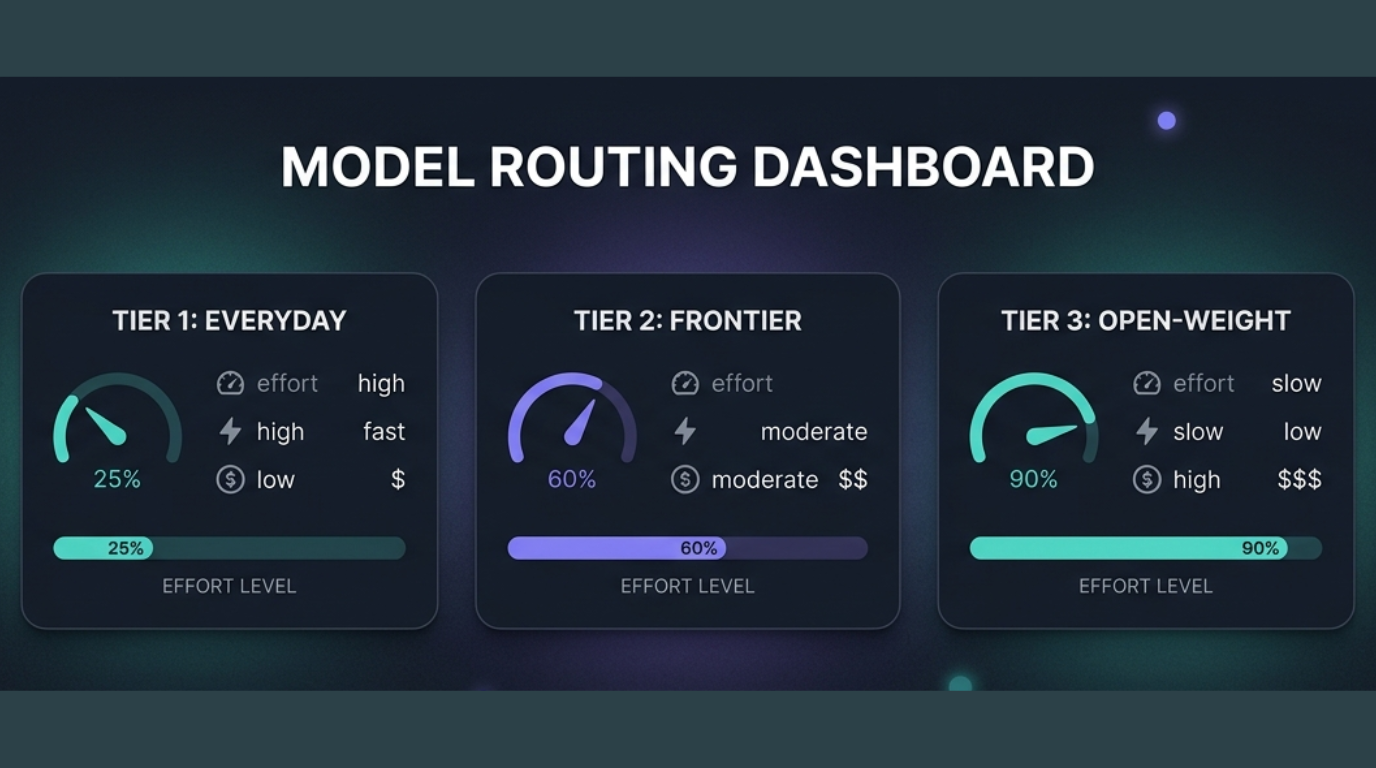
If you've been following the last couple of pieces on here, you know the running theme: as Anthropic's pricing structure has shifted (Fable 5's subscription split) and open-weight alternatives have gotten genuinely competitive (Kimi K3), the practical skill for anyone building agents isn't picking one model — it's routing intelligently across several. Opus 5 slots into that framework cleanly:
Opus 5 (effort-tuned per step) — the new default for most agentic coding, tool orchestration, and knowledge work. Use the effort ladder to tune cost per step instead of switching models.
Fable 5 — reserve for the narrow set of genuinely long-horizon, highly autonomous tasks where Anthropic itself still positions it as the stronger choice, and where its higher price is actually justified by task complexity.
Kimi K3 (once self-hosting is viable) — a cost lever for high-volume, simpler agentic tasks where an open-weight model's lower per-token cost matters more than marginal capability differences.
That's a meaningfully cheaper, more flexible stack than defaulting everything to whichever model just launched.
AIWerse Verdict
Opus 5 is a genuinely good release, and the "comes close to Fable 5 at half the price" pitch holds up under independent benchmarking — this isn't marketing spin outrunning the numbers. For the large majority of coding and agentic workloads, Opus 5 at a tuned effort level is very likely the better default than Fable 5, purely on cost-to-capability grounds.
That said, don't read this as "Fable 5 is obsolete." Anthropic's own positioning still reserves Fable 5 for the longest-running, most autonomous work, and the benchmark gaps that remain — narrow as they are — sit exactly in that territory (long-horizon engineering, the hardest real-world bug fixes). If your workload genuinely lives there, the price premium is still buying you something.
The bigger structural point: this is now the third model release in two months where Anthropic has shipped a cheaper, effort-tunable option that narrows the gap to its flagship. If you're building on these models, the safe assumption going forward is that today's "best model for the job" is provisional — plan your architecture for routing and effort-tuning, not for pinning everything to one model's current price and benchmark position.
FAQs
What is Claude Opus 5?
Claude Opus 5 is Anthropic's newest model in the Opus tier, released July 24, 2026. It's priced the same as its predecessor, Opus 4.8, but delivers meaningfully improved performance on coding, agentic, and knowledge-work benchmarks — close to, though not matching, Claude Fable 5's capability, at half Fable 5's price.
Is Claude Opus 5 better than Fable 5?
On most published benchmarks, yes, or very close — independent testing shows Opus 5 ahead on 7 of 12 shared benchmarks. Fable 5 holds a narrow lead on SWE-bench Pro and CursorBench, and Anthropic still positions Fable 5 as the better choice for the longest-running, most autonomous agentic work.
How much does Claude Opus 5 cost?
$5 per million input tokens and $25 per million output tokens — identical to Opus 4.8's pricing. Fast mode, which runs at roughly 2.5x standard speed, costs $10/$50 per million tokens.
What are Claude Opus 5's effort levels?
Opus 5 supports five effort settings — low, medium, high, xhigh, and max — letting you tune the model's reasoning depth (and cost) per request instead of switching between separate model tiers. One change from Opus 4.8: thinking can only be disabled at high effort or below; xhigh and max require thinking to stay on.
Is it worth switching from Opus 4.8 to Opus 5?
For most use cases, yes — pricing is unchanged and performance is substantially improved across coding, agentic, and knowledge-work benchmarks. Check whether any existing automation depends on disabling thinking at xhigh or max effort, since that specific combination is no longer available.
How does Claude Opus 5 compare to GPT-5.6 Sol?
Opus 5 leads on 9 of 12 shared benchmarks and costs 17% less on output tokens. GPT-5.6 Sol leads on terminal-agent tasks and offers significantly higher raw speed through Cerebras deployment, making it a stronger pick for latency-sensitive, terminal-heavy workflows.
Related News & Updates
Junaid Nawaz is the founder of AIwerse and a developer focused on AI tools, agentic workflows, and builder-focused tech. He covers AI model releases, coding tools, and platform updates for developers and teams building with AI. You can follow AIwerse on X (@AIwerse).