
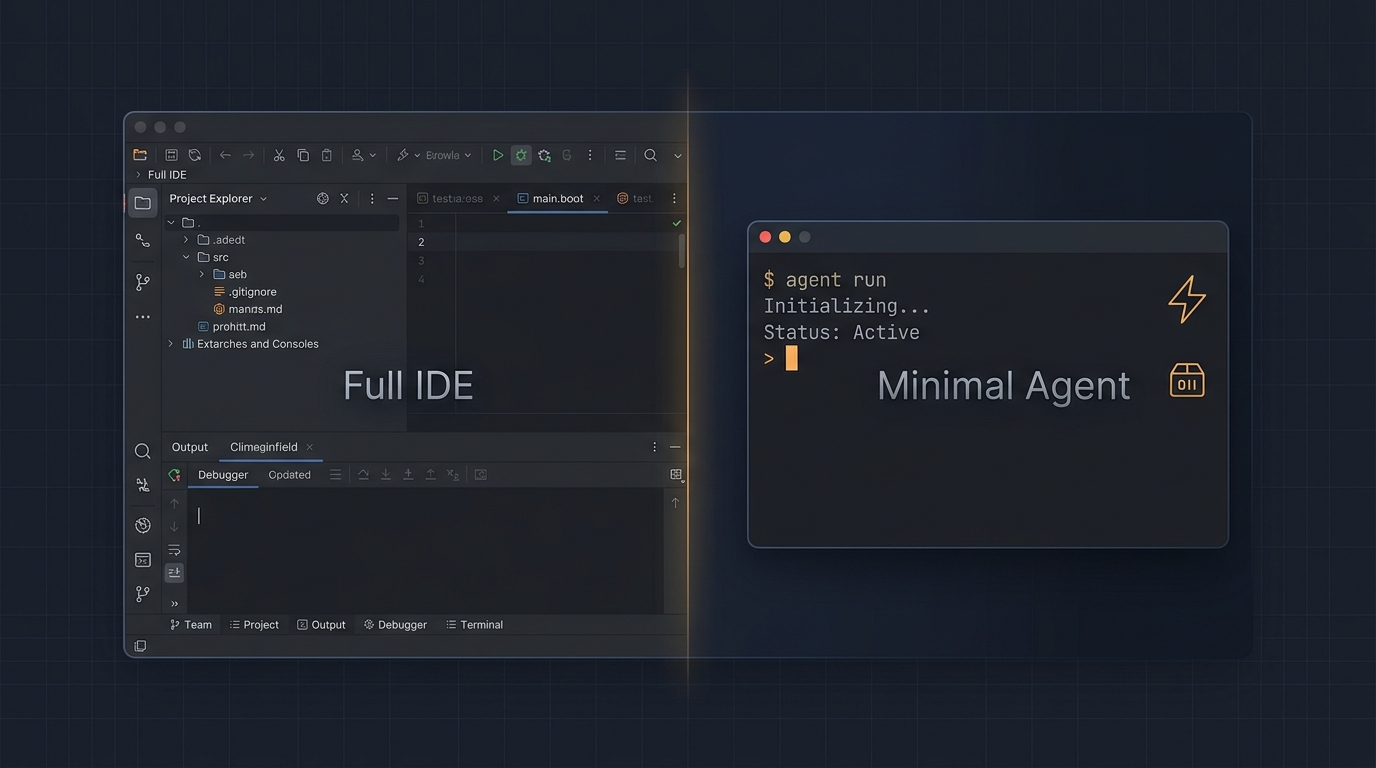
Quick summary:• Vercel Labs open-sourced fx (Apache-2.0), a lightweight, model-agnostic coding agent harness written in Zig. • Shipped as a single native binary, it is built as a fast, minimal alternative to full AI IDEs like Cursor or Windsurf. • Explicitly experimental, sparking developer debate on whether small size is the right feature to prioritize. |
|---|
What Vercel Just Shipped
On August 17, 2026, Vercel Labs released fx, a coding agent that started life as an internal tool and is now public on GitHub under an Apache-2.0 license. The pitch, in Vercel's own words, rests on three principles: fast, light, and open. It's a harness and CLI written in Zig — a systems language chosen specifically for ahead-of-time compilation and low overhead — and it's designed less like a chat-based coding assistant and more like a Unix utility that happens to talk to a language model.
That framing matters, because it's the whole argument of the product. Most AI coding tools right now are converging on the same shape: an editor or terminal UI, a large system prompt, a wide tool surface, and a growing list of built-in features. fx is a bet that a smaller, more composable core is the better foundation — not just for individual developers, but for teams building their own agent infrastructure on top of it.
The Numbers, With the Caveats Attached
Spec | Value | Source |
|---|---|---|
Language | Zig 0.16+ | GitHub repo, AGENTS.md |
License | Apache-2.0 | GitHub repo |
First public release | August 17, 2026 (v0.0.1, followed by v0.0.3 the next day) | Vercel launch post, GitHub Trendshift |
Binary size at launch | ~6.39 MiB | Vercel's official launch post |
Current README figure | ~7.8 MiB | GitHub README (as of this writing) |
Official production ceiling | 7.800 MiB, CI-enforced |
|
"Cold start" marketing claim | ~10 microseconds | Vercel's launch post — defined as time to accept input, before TTY initialization |
CI-enforced latency budget | Per-command budgets enforced on every PR; specific threshold not publicly stated |
|
Entry points | Interactive CLI, | GitHub repo |
Model support | Vercel AI Gateway (OpenAI, Anthropic, Google, DeepSeek, z.AI, Moonshot, and others), plus direct subscription auth for OpenAI Codex and xAI Grok | GitHub repo, TerminalTrove |
Two things worth sitting with before moving on.
First, the binary-size story isn't a launch-week fluke. The repository's own contributor guidelines confirm the project runs automated binary-size tracking on every pull request, with warnings triggered by growth of just 0.05 MiB — and separately, the guidelines state plainly that "the full macOS arm64 PGSO release qualification remains authoritative for the 7.800 MiB production ceiling and performance gates." In other words, 7.8 MiB isn't drift or bloat creeping in unnoticed. It's an official, CI-enforced engineering budget that the team is actively holding the line on, even as the binary has grown since the initial 6.39 MiB release build. That's a meaningfully different story than "they said tiny and it got bigger" — it's closer to "they said tiny, defined what tiny means precisely, and are policing it in CI."
Second, the '10 microsecond cold start' figure that's driven most of the headlines is a specific, narrow claim: it measures the time before fx accepts input, prior to terminal initialization. What's less publicized: the project's own CI pipeline enforces separate, stricter per-command latency budgets on every pull request, measured via hyperfine across six benchmarked CLI paths on Linux runners — and fails the build if a change regresses past that threshold. The specific number isn't published in the docs, but the existence of a hard, automatically-enforced ceiling (rather than just a marketing claim) says more about the team's actual engineering discipline than the 10-microsecond headline does.
The Actual Debate: Minimalism vs. the Full-IDE Approach
Here's where this gets more interesting than a typical tool announcement.
The dominant AI coding tools right now — Cursor, Windsurf, and to a lesser extent Claude Code — have converged on a "batteries included" model. Full editor integration, broad built-in tool sets, memory systems, extensive configuration surfaces. The value proposition is that the tool handles more of the surrounding workflow, so the developer thinks about the problem, not the plumbing.
fx is built on the opposite premise. Vercel Labs' own launch messaging is explicit about this: minimalism runs through "system prompt, tools, feature set, and binary" alike. The stated logic is that every token spent on the harness itself is a token not spent on your actual problem, so a smaller system prompt and a narrower tool surface should, in theory, leave more of the context window and more of the model's attention for the task at hand.
That's a real, defensible engineering argument. It's also not an uncontested one.
When fx hit Hacker News, the response wasn't uniform enthusiasm. One notable thread of skepticism, still worth taking seriously: for a program that's fundamentally an input loop, a context builder, an LLM call, and a tool dispatcher, why does the binary land in the multi-megabyte range at all? One commenter put a rough figure on it — arguing a truly minimal native agent doing that job "should" land closer to 200–300 KB. That's not a knockdown argument (Zig binaries carry standard library and runtime overhead that doesn't shrink to zero, and fx bundles WebAssembly build support, ACP protocol handling, and a full terminal rendering engine, not just a bare request loop) — but it's a fair challenge to the framing of "tiny," and it's the kind of pushback that's actually useful to sit with rather than wave away.
There's a second, quieter thread of skepticism too: does shaving milliseconds off startup actually matter when the bottleneck in any AI coding session is the model call itself, which routinely takes seconds? A coding agent that starts in 2 milliseconds instead of 200 milliseconds is not meaningfully faster in practice if the next step is a multi-second round trip to a language model. Where the speed argument holds up better is in narrower cases — CI pipelines invoking the agent thousands of times, or sandboxed environments where every millisecond of overhead compounds across parallel sessions.
Neither side of this argument is obviously wrong. The honest read is that fx optimizes hard for a specific set of properties — binary size, memory footprint, harness token overhead, embeddability — that matter enormously in some contexts and barely register in others.
Where This Actually Makes Sense (and Where It Doesn't)
fx looks like a strong fit for a specific set of use cases: embedding a coding agent inside a CI pipeline or automated sandbox, building custom agent infrastructure where you want a small, extensible core rather than a full product to work around, running in genuinely resource-constrained environments, or research work where you want to observe and modify agent behavior at a low level without fighting a large, opinionated codebase.
It looks like a weaker fit as a daily-driver replacement for Cursor or Claude Code today. Vercel Labs labels the project experimental in its own documentation and warns of frequent breaking changes. The permission model, session management, and skills/plugin/MCP extensibility are all present and genuinely capable on paper, but this is a v0.0.x release from a team that's explicit about instability, not a mature product competing feature-for-feature with tools that have had years of daily-use hardening.
That's not a knock. It's a different product category wearing similar clothes. Cursor and Windsurf are trying to be the environment you work in all day. fx is trying to be the thing other tools get built on top of.
How to Try It
Installation is a single command:
curl -fsSL https://fx.sh/setup.sh | bashOr build from source directly:
git clone https://github.com/vercel-labs/fx.git
cd fx
zig build -Doptimize=ReleaseSafe
./zig-out/bin/fx
Authentication runs through fx login for Vercel AI Gateway access, or direct subscription sign-in for OpenAI Codex and xAI Grok — both of which store credentials locally and never route through Vercel's own infrastructure, according to the project's documentation. Full setup and command reference live at the project's GitHub repository and fx.sh.
AIWerse Verdict
fx is genuinely interesting engineering, and Vercel Labs has been unusually transparent about what its numbers actually mean — the CI-enforced size ceiling and the honest distinction between marketing-friendly and engineering-accurate latency figures are both signs of a team that takes its own claims seriously. But it's not, today, a Cursor or Claude Code replacement for most developers, and Vercel isn't claiming it should be. It's a signal about where a segment of agent tooling is heading — toward small, embeddable, composable cores rather than monolithic IDEs — and it's worth watching closely if you build agent infrastructure for a living. For everyone else, it's worth trying, not necessarily worth switching to.
FAQ
What is Vercel's fx?
fx is an open-source coding agent harness and CLI, written in Zig by Vercel Labs and released publicly on August 17, 2026 under the Apache-2.0 license. It's built to be small, fast-starting, and embeddable, rather than a full AI-powered IDE.
Is fx a replacement for Cursor or Claude Code?
Not currently, and Vercel Labs doesn't position it that way. fx is labeled experimental with expected breaking changes, and it targets a different use case: embedding, automation, and minimal footprint, rather than a polished daily-driver development environment.
What models does fx support?
It's model- and provider-agnostic. It works through the Vercel AI Gateway (which covers OpenAI, Anthropic, Google, DeepSeek, z.AI, Moonshot, and other providers), and it also supports direct subscription authentication for OpenAI Codex and xAI Grok, with credentials stored locally rather than routed through Vercel.
Is fx production-ready?
No, not by Vercel's own labeling. It's an experimental v0.0.x release, and the project explicitly warns of frequent changes. It's better suited to research, CI/sandbox environments, and teams building on top of it than to critical production workflows today.
How big is the fx binary, really?
It launched at roughly 6.39 MiB. As of this writing, the GitHub README lists approximately 7.8 MiB, which matches the project's own CI-enforced production ceiling of 7.800 MiB documented in its contributor guidelines — meaning the growth is a tracked, intentional engineering budget rather than unmanaged bloat.
Related News & Updates
Junaid Nawaz is the founder of AIwerse and a developer focused on AI tools, agentic workflows, and builder-focused tech. He covers AI model releases, coding tools, and platform updates for developers and teams building with AI. You can follow AIwerse on X (@AIwerse).